

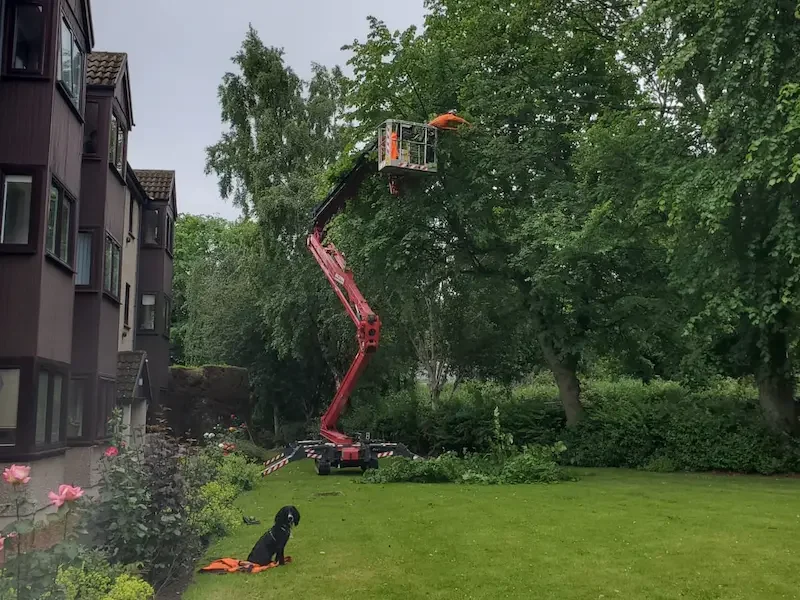
Following a tree safety survey carried out earlier in the year for one of our regular factoring company clients, we returned to a residential development near Portobello to undertake the recommended tree works.
The survey had identified a row of semi-mature broadleaved trees that had originally been planted too close to the stone boundary wall. With the trees now established within a relatively constrained rooting environment and in close proximity to the residential development, careful management was required.
Rather than carrying out an unnecessarily heavy reduction, we specified a sympathetic crown reduction to reduce the overall sail area of the trees while retaining sufficient live crown to maintain their vitality and natural appearance.
Accessing the trees with a spider MEWP
Access through the communal garden was limited, so we used a compact spider MEWP capable of reaching the trees while fitting through the restricted access.
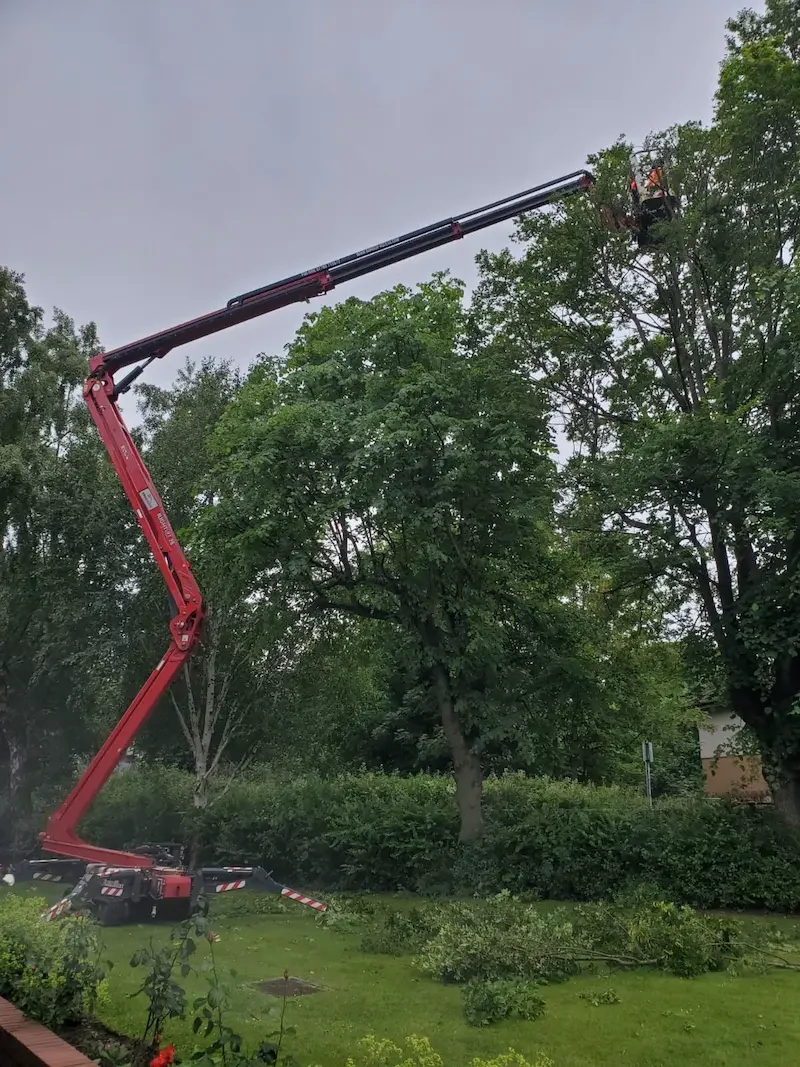
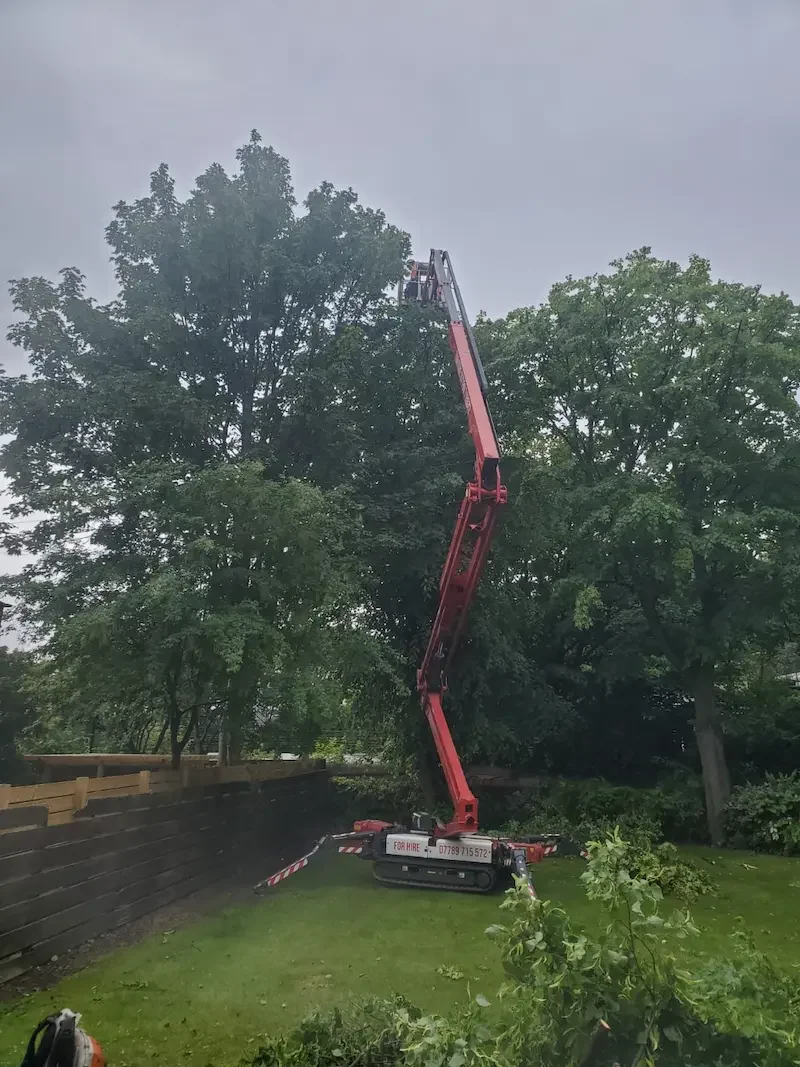
Working from the MEWP allowed our arborists to selectively reduce the crowns in accordance with BS 3998:2010 – Tree Work: Recommendations. Particular care was taken to maintain a natural crown shape and avoid excessive pruning.
Over-pruning or topping may provide an immediate reduction in tree size, but it can stimulate dense, poorly attached regrowth and create additional management and safety issues in subsequent years. Our aim was therefore to achieve the required reduction while retaining a balanced, natural-looking crown.
Removal and replacement planting
While on site, we also removed a Silver Birch that had been identified as dangerous during the earlier survey. Following removal, the stump was ground out to allow the area to be replanted.
Replacement Sorbus ‘Eastern Promise’ trees were then planted, this time allowing suitable clearance from the boundary wall to give them adequate space to establish and develop.
The completed works provide a good example of how tree surveying, appropriate pruning and considered replacement planting can be combined to manage trees safely without resorting to unnecessarily severe pruning.